
Strata and Qwen: running a 125B Qwen model on a gaming PC
What the open-source Strata engine does, how it fits Qwen3.8-Flash-Next into 12 GB of VRAM, the speeds its authors report, and the trade-offs to know before you install it.
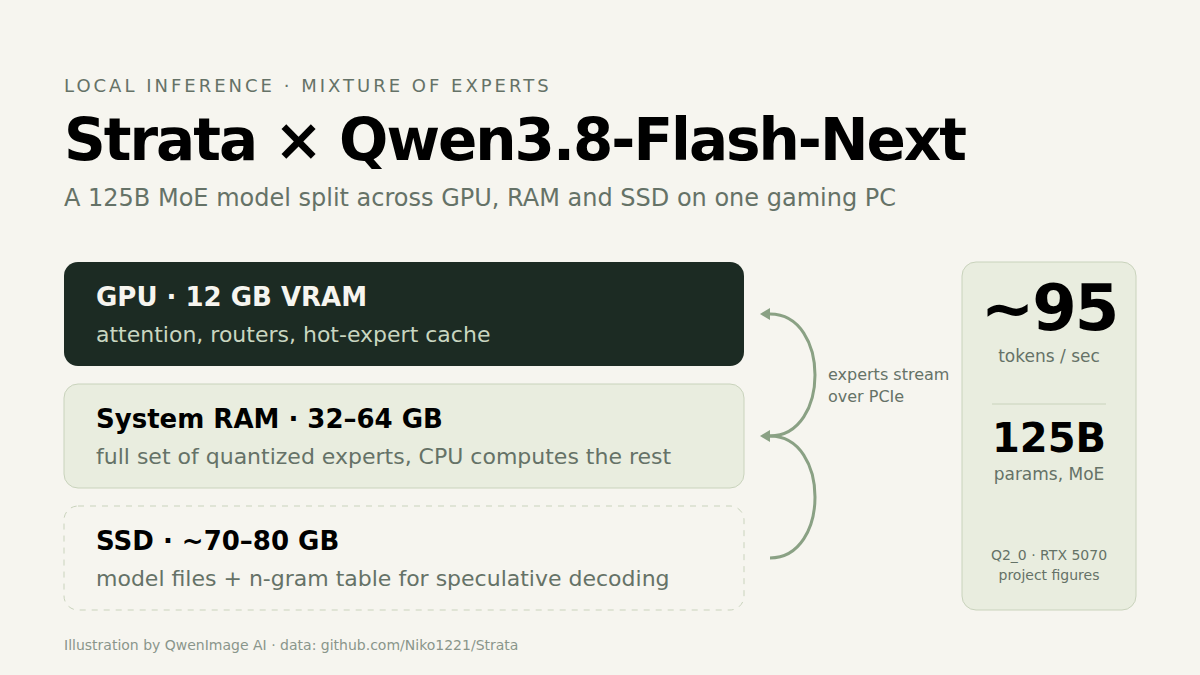
If you have seen "Strata Qwen" in your feed lately, it refers to Strata, an open-source inference engine published on GitHub as Niko1221/Strata. Its pitch is simple: run Qwen3.8-Flash-Next, a 125-billion-parameter Mixture-of-Experts (MoE) language model, on an ordinary gaming PC, with a one-click installer and a local API.
This note summarizes what the project says about itself, so you can decide whether it is worth the disk space. Strata is a text (and optional image-input) language model runtime. It is not related to the image generation in our studio, which is built on Qwen Image 2.1.
What Strata is
According to its README, Strata is a local inference engine for Windows and Linux under the MIT license. The installer (START-HERE.bat on Windows, ./setup.sh on Linux) detects your graphics card, recommends a model size, downloads the weights and starts a server at http://127.0.0.1:8080. From there you get:
- a browser chat UI on localhost;
- an OpenAI-compatible API at
/v1and an Anthropic-compatible endpoint at/v1/messages; - an MCP server for coding assistants;
- optional image input, a live GPU/CPU/RAM dashboard, adjustable reasoning effort and multi-GPU support.
Besides the main model, the project lists a "Coder" variant with roughly half the experts, which lowers the RAM requirement.
How it fits a 125B model into 12 GB
An MoE model only activates a small subset of its experts for each token, and Strata leans on that. The project's technical notes describe a three-tier layout:
- GPU holds attention layers, the routers and an adaptive cache of frequently used experts. The notes say every extra GB of VRAM holds roughly 700 more experts.
- System RAM holds the full set of quantized experts, and the CPU computes the experts that are not cached on the GPU, in parallel.
- SSD stores the model files and an n-gram table used for speculative decoding.
Two further tricks do much of the work. Experts are dequantized lazily and streamed to the GPU over PCIe in chunks, and the model's built-in multi-token-prediction layer drafts about 2.4 to 3.2 tokens per verification pass.
Reported speed
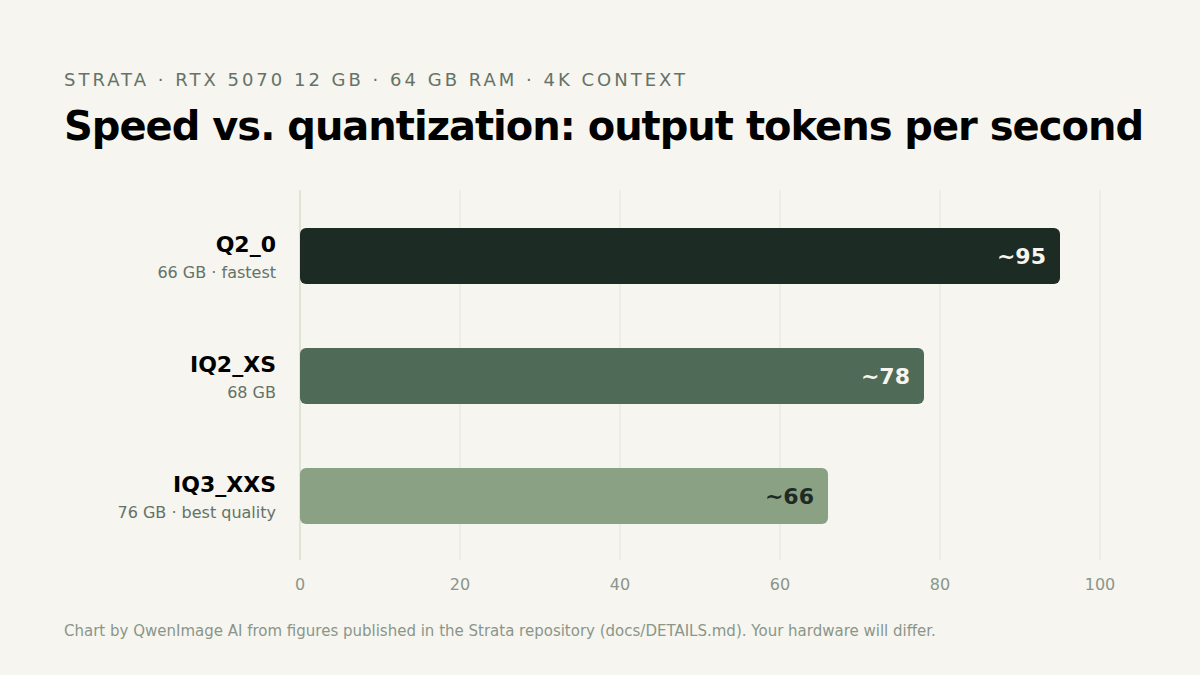
The chart above uses the figures published in the repository for an RTX 5070 (12 GB) with 64 GB of RAM at a 4K context:
- Q2_0 (about 66 GB): about 95 tokens/s, the fastest pack.
- IQ2_XS (about 68 GB): about 78 tokens/s.
- IQ3_XXS (about 76 GB): about 66 tokens/s, the highest fidelity of the three.
Speed drops as context grows: the notes list about 56 tokens/s for Q2_0 at the full 262K context. An independent write-up on note.com measured similar results (about 93 tokens/s for Q2_0 at short context and about 74 tokens/s at 128K) on an RTX 5070 with a Ryzen 5 7600 and 64 GB of RAM. Treat all of these as best-case numbers for that class of machine; PCIe bandwidth, RAM speed and the CPU all matter.
What you need
The project lists these requirements:
- an NVIDIA RTX GPU with at least 12 GB of VRAM (AMD Radeon RX 7900/9000 are also mentioned in the README);
- 64 GB of RAM recommended; the README gives 32 GB as a minimum, and the technical notes give 48 GB for the smaller packs;
- 70 to 80 GB of free SSD space;
- a recent driver (the notes say NVIDIA 580+) and an x86-64 CPU with AVX2.
Trade-offs to keep in mind
- Quality. These are 2- and 3-bit quantizations of a much larger model. The authors themselves acknowledge a quality gap relative to the official full-precision model; IQ3 packs narrow it at the cost of speed.
- One request at a time. The server processes requests sequentially, so it is a personal tool rather than a shared endpoint.
- Slow first load. The README warns that the PC may freeze for one to three minutes while the model loads, and a long first prompt takes roughly a minute per 30,000 tokens.
- Platform gaps. Image input on AMD cards is Linux-only.
Our take
Strata is a good example of how far MoE sparsity, expert caching and aggressive quantization can push local inference. If you have a 12 GB card, 64 GB of RAM and a spare 80 GB of SSD, it is a practical way to get a private, OpenAI-compatible endpoint backed by a very large Qwen model. Check the repository for the latest requirements before installing, since a fast-moving project can change quickly.
If you are here for images rather than text, the QwenImage AI studio is where you can try Qwen Image 2.1 prompts.